How Many Driving Lessons Do You Need Before You’re Test-Ready in Manchester?
Posted on September 17, 2026 by saqibstares
The DVSA’s own figures put the UK average at around 45 hours of professional lessons, plus roughly 22 hours of private practice. That number gets quoted everywhere, but it’s a national average, not a target to aim for. What actually determines your lesson count is your starting point, how often you drive, and how the test centres in your own area behave. No one can promise you a fixed number upfront.
Quick Answer
Most learners in Manchester need 30 to 50 hours of professional lessons to become test-ready, on top of any private practice. The UK-wide average is 45 hours, but your own number depends on your starting point, how often you drive, and which local test centre you’re using. A test preparation or assessment lesson gives you a realistic figure for your own progress rather than relying on the national average.
The National Average Number of Driving Lessons, and Why It’s Only a Starting Point
45 hours is an average across every learner in the country, including complete beginners and people restarting after a long gap. Some learners reach test-ready in 25 to 30 hours, especially with regular lessons and private practice in between. Others need 60 or more. That isn’t a reflection of ability. It usually just means the gaps between lessons were too long, or the early stages needed more repetition to become automatic.
The learners who get there fastest are rarely the ones who booked the most hours. They’re the ones whose lessons were spaced closely enough that each one built on the last, instead of re-covering ground they’d already half-forgotten.

What Actually Changes Your Lesson Count
A few factors matter far more than any generic hour count:
- Prior experience: learners who’ve driven abroad, ridden a motorbike, or had informal practice in a car park usually need fewer hours on vehicle control and more on UK-specific rules and road positioning.
- Lesson frequency: two lessons a week almost always gets you test-ready in fewer total hours than one lesson every fortnight, because skills stay fresh instead of needing to be rebuilt each time.
- Private practice: supervised practice with a family member between lessons (where insurance allows it) can meaningfully cut down the number of paid hours needed for basic control skills.
- Nerves: anxious learners often need more time not because of ability, but because confidence has to be built alongside the technical skills. Our nervous driver lessons are built around this. Rushing this stage tends to add hours later, not save them.
- Manual vs automatic: automatic learners typically need fewer hours overall, since there’s no clutch control or gear changes to master on top of everything else.
What to Expect From Your First Few Lessons
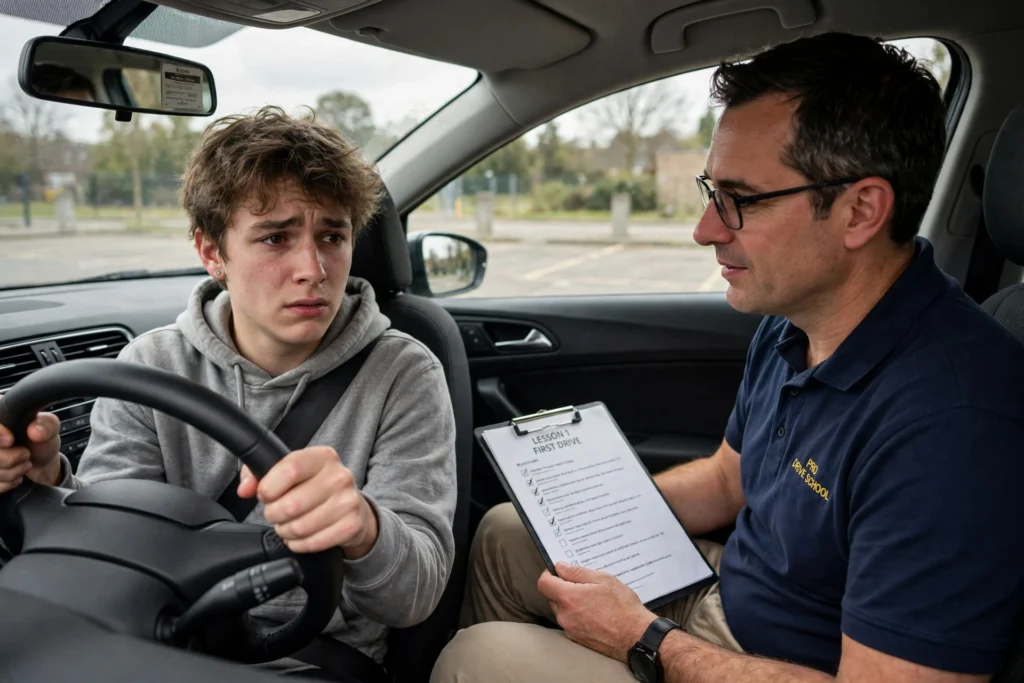
Your starting point matters more than any hour count, so it helps to know what the first few lessons actually cover. Early sessions focus on the basics: vehicle controls, moving off and stopping smoothly, steering, observations and simple junctions, usually in quieter residential areas before moving on to busier roads.
If you’re completely new to driving, our beginner driving lessons are structured around this gradual build-up, so you’re never thrown into traffic you’re not ready for. Bring your provisional licence to your first lesson, wear flat, comfortable shoes, and don’t worry about getting things wrong, a good instructor expects it and adjusts the pace to how you’re actually progressing, not a fixed lesson plan.
If you’ve already had some lessons elsewhere and want a fresh assessment, switching instructors partway through doesn’t mean starting over. See our guide on changing driving instructor in Manchester for how that works.
Signs You’re Test-Ready (Hour Count Aside)
Counting hours is a rough guide at best. What actually matters on test day is whether these have become automatic rather than things you’re consciously thinking through:
- You move off and stop under control without being prompted
- You judge junctions and roundabouts independently, most of the time
- Mirror and shoulder checks happen without reminders
- You maintain a safe road position naturally, not just when you remember to
- You can follow directions or sat nav instructions while staying in full control of the car
- A missed instruction or unexpected hazard doesn’t throw off your driving for the next few minutes
If most of these still need regular intervention from your instructor, more lessons will help more than booking the test early and hoping for the best.
Why Manchester’s Test Centres Affect the Number Too
Generic national guides can’t account for this, but where you’re testing genuinely changes how many lessons you need. Cheetham Hill, Chadderton, Sale and West Didsbury test centres each sit on different types of roads, and your lessons should reflect that. A learner testing at Cheetham Hill needs confidence in dense inner-city traffic and tighter junctions. A Sale test route, by contrast, includes more open roads and roundabouts around Trafford. Practising generic skills in a quiet area, then testing somewhere with unfamiliar traffic, is one of the most common reasons learners need extra lessons they didn’t expect.
This is why our lessons are built around the actual test centre you’re using, not a generic curriculum, and it’s part of why our pass rate sits well above what a purely hour-counted approach would predict.
Weekly Lessons vs an Intensive Course: Which Needs Fewer Hours?
Both approaches can reach the same total hours, but not always the same way. Weekly lessons suit learners who want to build skills gradually alongside work, college or family commitments, spread over a few months. An intensive driving course compresses the same learning into a shorter period instead. It works well for learners who already have some experience and want to stay sharp right up to test day, rather than losing momentum between lessons booked weeks apart.
| Factor | Weekly Lessons | Intensive Course |
|---|---|---|
| Typical pace | 1 to 2 lessons per week | Several hours per day, over 1 to 3 weeks |
| Best for | Beginners, learners balancing work, college or family commitments | Learners with some prior experience who want to stay sharp right up to test day |
| Typical duration | 2 to 6 months | 1 to 3 weeks |
| Total hours needed | Similar overall, spread over more weeks | Similar overall, condensed into fewer days |
| Risk of forgetting skills between sessions | Higher if gaps between lessons are long | Lower, since lessons are close together |
Neither route reliably needs fewer total hours than the other.
What it comes down to is which pace actually suits how you learn, and whether your schedule can support the frequency each option needs to work.
What This Means for Your Budget
At £37 to £39 an hour depending on your postcode, the difference between 30 hours and 50 hours of lessons is a genuinely significant amount of money. That is exactly why it’s worth getting an honest assessment early, rather than guessing. Block bookings bring the per-hour cost down if you already know you’ll need regular lessons. An assessment or test preparation lesson can give you a realistic estimate of where you actually stand, rather than relying on a national average that may not apply to you. Full rates for your postcode are on our lesson prices page.
Extra practice can help. Read our guide to practising with family or friends.
However many hours you need, the starting point is the same: structured driving lessons in Manchester with a DVSA-approved instructor and a clear plan for your test date.
Frequently Asked Questions
New to the process? GOV.UK explains the official steps to learn to drive a car, from provisional licence to test day.
Get an Honest Estimate, Not a Guess
Want to know where you actually stand rather than relying on a national average? Read how other learners got there in our real student success stories, or check lesson prices and availability in your area to get started.